Water Damage Repairs
When Does Water-Damaged Flooring Need to Be Replaced?
8 min read · Last reviewed August 2, 2026
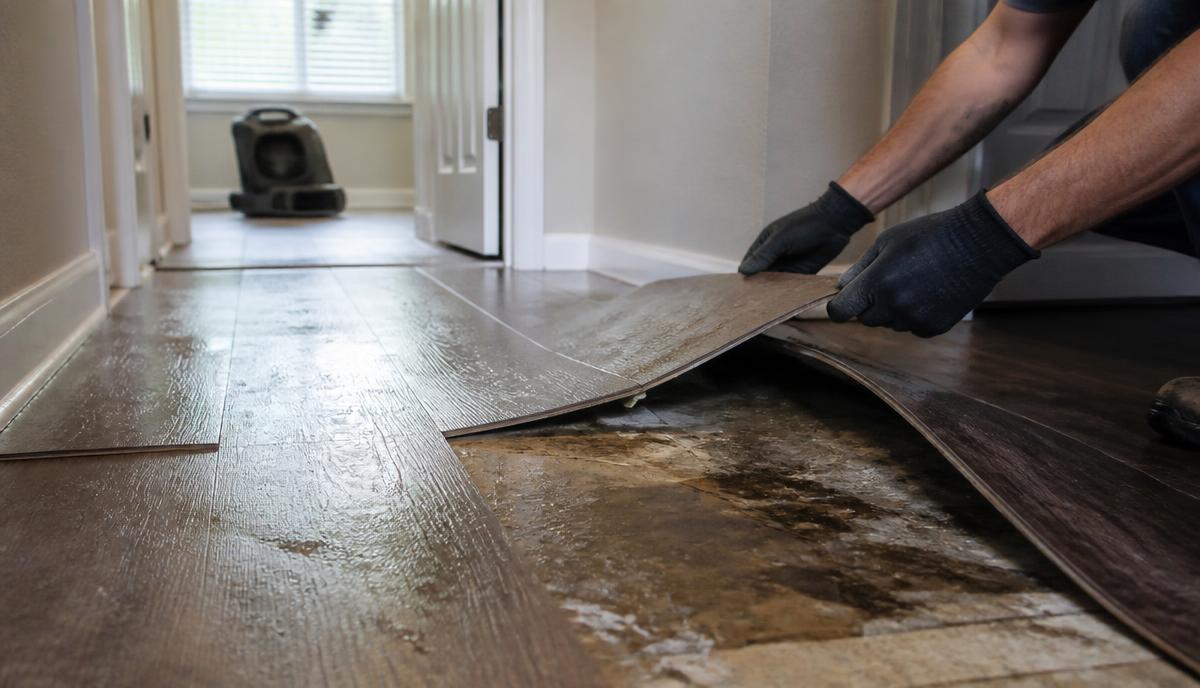
Flooring is the most commonly replaced material after water damage, and often for the wrong reason: the visible surface gets judged while the assembly beneath it is ignored.
This guide works through each material and then the part that matters most — the subfloor.
Key takeaways
- Carpet can often be saved; the pad beneath it usually cannot.
- Solid hardwood sometimes recovers with fast, specialised drying; laminate rarely does.
- Tile may survive while the setting bed and subfloor beneath stay wet.
- Never install new flooring over a subfloor that has not been verified dry.
By material
Carpet and pad
With clean water and a fast response, carpet can often be extracted, cleaned, and dried in place — but the pad acts like a sponge and is normally removed and replaced. With contaminated water, both go.
Solid hardwood
Hardwood cups when it absorbs water from below. Cupping alone is not a death sentence: with rapid drying, sometimes using mat systems that pull moisture through the boards, floors frequently flatten out and can be sanded and refinished. Crowning, splitting, or boards lifting off the fasteners is a different matter.
Engineered wood and laminate
Both are layered products bonded with adhesive. Once water reaches the core, edges swell and the layers separate, which is irreversible. Laminate in particular almost always needs replacing after standing water.
Vinyl, LVP, and sheet goods
The material itself is water-resistant, which is exactly the problem: it traps water underneath. Planks and sheet vinyl usually have to come up so the subfloor can dry, even when the flooring is undamaged. Click-lock planks can sometimes be lifted and reused.
Tile and stone
Tile over concrete usually survives. Tile over a wood subfloor may survive while the wood beneath does not. Hollow-sounding tiles or cracked grout lines after a soaking suggest the setting bed has been compromised.
The subfloor decides
Plywood tolerates wetting reasonably well and often dries. OSB and particleboard swell at the edges and lose strength, and particleboard underlayment in particular rarely recovers.
Concrete slabs do not rot, but they hold and release moisture for a long time. Installing an impermeable floor covering over a slab that is still releasing moisture is a reliable way to cause a second failure.
- Check for soft spots, deflection, and squeaks that were not there before
- Take readings at multiple points, including beneath cabinets and along walls
- For slabs, ask about a moisture test appropriate to the new flooring product
Making the call
Weigh four things: how long the material was wet, what kind of water it was, whether the assembly can dry with the floor in place, and whether the material has physically deformed. Two or more negatives usually point to replacement.
Cost matters too. Specialty drying of a large hardwood floor can approach the price of replacement; on a small area it is clearly worth it.
Questions homeowners often ask
Should wet flooring be replaced?
Not automatically. Carpet, solid hardwood, and tile are often salvageable. Laminate, engineered wood, and particleboard underlayment usually are not.
Can water damage occur under vinyl flooring?
Yes, and it is common. Vinyl resists water from above and traps it from below, so the subfloor can stay wet for a long time with no visible sign.
Frequently asked questions
Continue reading
- Water Damage Repairs in Mobile AL: When Restoration Is Not Enough
Understand when water-damaged materials need repair or replacement rather than drying — drywall, flooring, ceilings, and structural components — with local context for Mobile, Alabama.
- How Long Does Water Damage Take to Dry?
Typical drying timelines by material and severity, what makes drying slower, and how moisture readings — not appearance — determine when a structure is actually dry.
- When Should Wet Drywall Be Repaired or Replaced?
How to judge whether water-damaged drywall can be dried and saved or has to be cut out, including flood cuts, insulation, and what to check before closing a wall.
- What Homeowners Should Know About Water Damage and Insurance Claims
How water damage claims are generally evaluated, the difference between sudden damage and gradual leaks, what to document, and the order of steps that protects your claim.
- Water Damage Restoration Cost in Mobile, AL: What Homeowners Should Know
Understand what drives water damage restoration costs in Mobile, Alabama — from extraction and drying to hidden moisture, materials, insurance, and how to read an estimate.
Last reviewed August 2, 2026. This guide is general educational information and is not a substitute for an on-site assessment of your property.