Water Damage Restoration
What Happens During the Water Damage Restoration Process?
9 min read · Last reviewed August 6, 2026
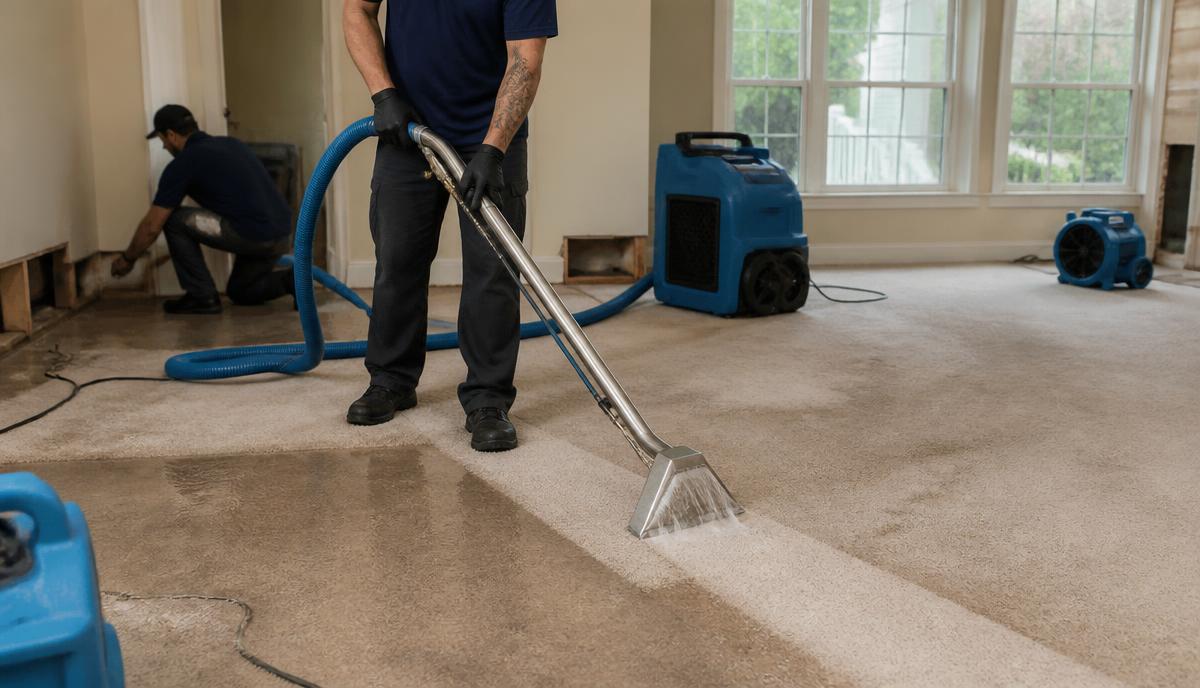
Restoration follows a fairly consistent sequence regardless of who performs it. Knowing the steps lets you tell whether a job is being run properly and lets you ask questions at the right moments.
Key takeaways
- Inspection and water classification come before any equipment is placed.
- Extraction removes far more water than evaporation ever will — it is the highest-value step.
- Daily documented readings are the backbone of a legitimate drying job.
- Clearance is a measurement, not an opinion.
Step 1: Inspection and source control
The first task is finding and stopping the source. Then the technician maps the affected area, using moisture meters and often thermal imaging to trace how far water travelled — which is nearly always further than it looks.
The affected area is marked, photographed, and recorded with baseline readings, including control readings from unaffected areas of the same materials.
Step 2: Classifying the water and the loss
Water is generally described in three categories: clean water from a supply line or rainwater; grey water from appliances, sinks, or clean water that has sat and degraded; and black water from sewage, or floodwater from outdoors.
The category drives what can be saved. Porous materials touched by black water are removed, not cleaned. The category can also change over time — clean water left standing becomes grey water within a couple of days.
Step 3: Extraction
Standing water is pumped or vacuumed out, and carpet is extracted with weighted or heavy-duty units. This step matters enormously: removing liquid water mechanically is many times faster and cheaper than evaporating it.
Step 4: Controlled demolition
Materials that cannot be dried in place come out: wet carpet pad, saturated insulation, damaged drywall, unsalvageable underlayment. Cabinet toe kicks may be drilled and baseboards removed to open cavities to airflow.
This is the point to make sure photographs of what is behind those materials exist.
Step 5: Drying and dehumidification
Air movers are positioned to sweep air across wet surfaces at a shallow angle, accelerating evaporation. Dehumidifiers then remove that vapour from the air so it does not simply redeposit elsewhere in the building.
The space is normally kept closed. In humid climates, opening windows introduces more moisture than it removes.
Step 6: Monitoring
Technicians return daily to record temperature, relative humidity, and moisture content at the same marked points. Progress should be visible day over day; a stalled reading triggers a change to the plan rather than more waiting.
You are entitled to see these logs. A job without daily documentation is difficult to defend to an insurer.
Step 7: Cleaning and clearance
Affected surfaces are cleaned, and antimicrobial treatment is applied where the water category or duration warrants it. Deodorising addresses residual smell.
Equipment comes out when readings on affected materials match the control readings and hold. The homeowner should receive a final report with the readings, photos, a list of removed materials, and the dates equipment ran.
Questions homeowners often ask
How long does water damage restoration take?
Commonly three to five days of drying for a contained loss, longer where cavities, hardwood, or dense materials are involved.
What happens during a water damage inspection?
The source is identified, the moisture map is established with meters and imaging, the water is classified, and baseline readings and photographs are recorded.
Can water-damaged materials be saved?
Often, if drying begins quickly and the water was clean. Porous materials exposed to contaminated water are removed.
Frequently asked questions
Continue reading
- Water Damage Restoration vs. Water Damage Repair: What's the Difference?
Restoration dries and stabilises; repair rebuilds. Understand the difference, how the two phases connect, who does each, and how it affects estimates and insurance.
- How Long Does Water Damage Take to Dry?
Typical drying timelines by material and severity, what makes drying slower, and how moisture readings — not appearance — determine when a structure is actually dry.
- What to Do in the First 24 Hours After Water Damage
A clear, ordered plan for the first day after discovering water damage: safety, stopping the source, documentation, extraction, and the decisions that affect your insurance claim.
- Water Damage Restoration in Mobile: What Homeowners Should Know
How water damage restoration works for homes in Mobile, Alabama — the drying process, Gulf Coast humidity, storm-driven intrusion, and how to tell when a property is truly dry.
- Water Damage Restoration Cost in Mobile, AL: What Homeowners Should Know
Understand what drives water damage restoration costs in Mobile, Alabama — from extraction and drying to hidden moisture, materials, insurance, and how to read an estimate.
Last reviewed August 6, 2026. This guide is general educational information and is not a substitute for an on-site assessment of your property.